Voice AI Surveys vs Google Forms: Response Rates, Data Quality & Why India Is Different
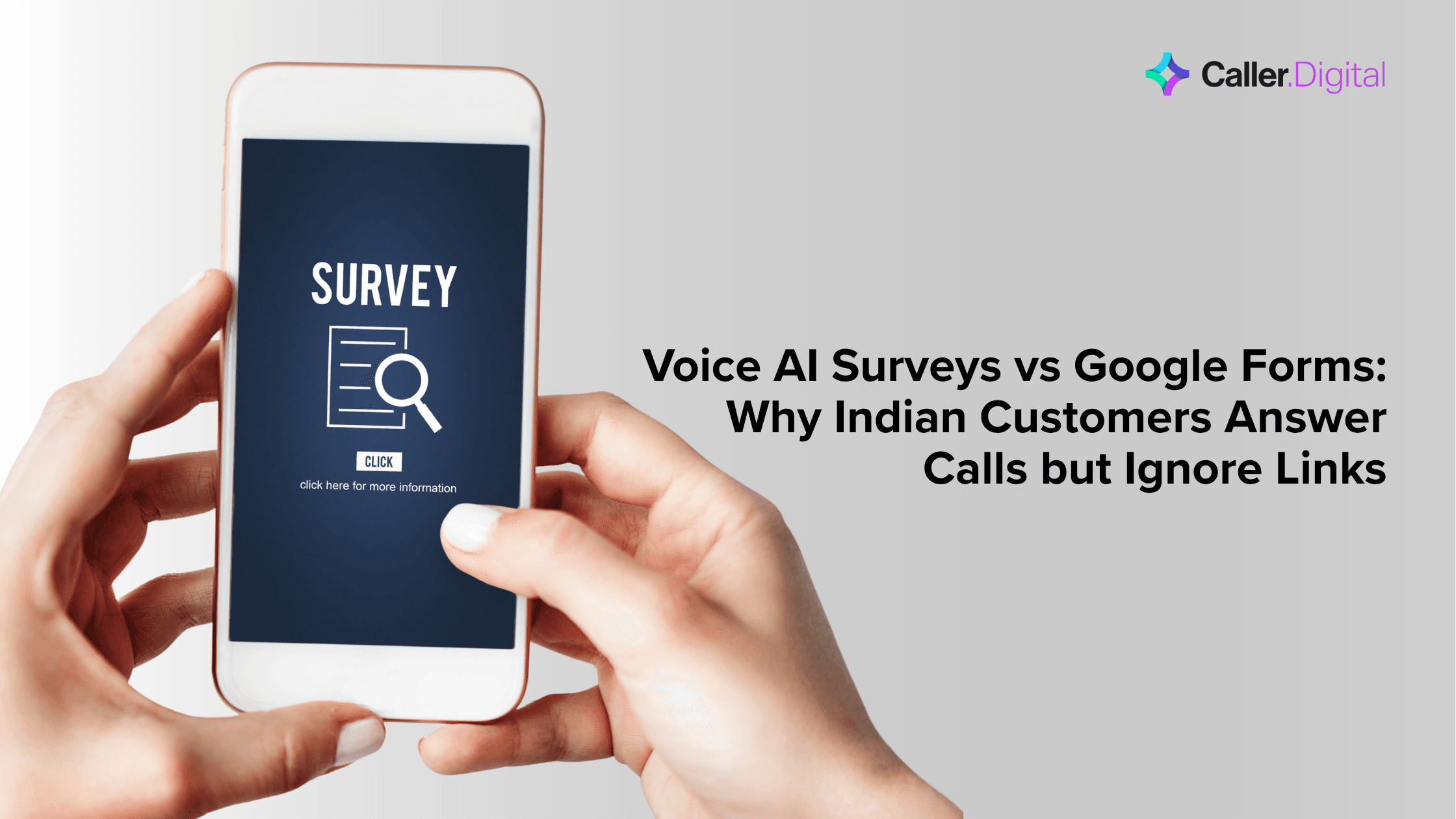
Your operations team sends a post-purchase Google Form to 10,000 customers every month. Four hundred and thirty-one fill it in. The NPS report is built from those 431 responses. Leadership reviews the score. Nobody asks where the other 9,569 customers went — whether they were satisfied, angry, or somewhere in between.
This is the quiet failure of form-based feedback programmes in India. Not a dramatic collapse. Just a slow erosion of signal until the data you're acting on represents 4% of your customer base and you've convinced yourself it's representative.
AI voice call surveys do not fix this problem incrementally. They fix it structurally. A well-run AI voice NPS programme in India achieves a 45-65% response rate from the same customer list. That is not a marginal improvement. That is a different business intelligence asset.
This piece is a direct comparison. We will cover response rates by channel, the specific mechanics of why voice outperforms forms in Indian markets, where Google Forms remains the right tool, how to run NPS and CSAT calls by voice, what the data quality difference looks like in practice, and how to migrate your existing feedback programme.
The Survey Completion Crisis in India
The average Indian consumer receives dozens of survey links per week. After a Swiggy delivery, a HDFC transaction, an Airtel recharge, a BigBasket order, a Myntra return — each of these events generates at least one feedback request. Usually a link. Sometimes two.
The result is link fatigue. Not disinterest in giving feedback — Indian consumers are demonstrably willing to talk about their experiences — but a reflexive dismissal of survey links as ambient noise. The link is seen, not opened. Or opened, not completed. Or completed once, and never again.
The data reflects this. For B2C businesses running customer feedback and surveys automation in India:
- Post-purchase Google Form response rate: 4-8%
- Email-embedded survey response rate: 9-14%
- SMS survey link response rate: 6-12%
- WhatsApp survey link response rate: 18-28%
- AI voice call survey response rate: 45-65%
Three structural reasons explain the gap, and they are specific to India rather than universal.
Reason 1: Link fatigue is worse in India than anywhere else. Hyper-app penetration — food delivery, quick commerce, banking apps, telecom apps, OTT platforms — means Indian urban consumers interact with more digital services per day than consumers in most comparable markets. Each service has a survey programme. The cumulative signal is: survey links are marketing overhead, not personal communication.
Reason 2: Mobile form completion is friction-heavy. Filling a survey on a smartphone requires switching between apps, loading a web page, and — critically — typing. For customers whose primary language is Hindi, Gujarati, Tamil, or Marathi, typing on a mobile keyboard is cognitively expensive. The English-language form that feels quick on a laptop feels like effort on a Redmi phone in Nagpur. The friction is not psychological; it is physical.
Reason 3: Voice is the dominant communication mode in Tier 2-3 India. In cities like Patna, Surat, Coimbatore, Indore, and Lucknow — collectively home to more consumers than Delhi and Mumbai combined — phone calls are how people communicate. WhatsApp voice notes. Incoming calls answered without screening. A phone ringing is an event that gets a response. A link is noise.
Response Rate Comparison: Every Channel, Head to Head
The table below shows median response rates across feedback channels for Indian B2C enterprises, broken down by city tier and including verbatim capture quality and effective cost per completed response.
| Channel | Avg Response Rate | India Tier 1 | India Tier 2-3 | Verbatim Capture | Cost per Response |
|---|---|---|---|---|---|
| Google Forms | 4-8% | 6-8% | 2-4% | Low (6-12 avg words) | ₹25-80+ (at low volume) |
| Email Survey | 9-14% | 11-14% | 5-8% | Low (8-15 avg words) | ₹15-30 |
| SMS Survey Link | 6-12% | 8-12% | 4-7% | None (link only) | ₹12-25 |
| WhatsApp Survey Link | 18-28% | 22-28% | 14-20% | Low (if form) | ₹10-20 |
| WhatsApp Native Form | 22-32% | 26-32% | 16-24% | Low-Medium | ₹12-22 |
| Automated IVR (legacy) | 6-11% | 7-11% | 5-9% | None (keypad only) | ₹8-18 |
| AI Voice Call | 45-65% | 48-62% | 52-68% | High (40-80 avg words) | ₹10-16 |
Two observations from this table deserve emphasis.
First, the Tier 2-3 performance inversion. Google Forms response rates in Tier 2-3 cities (2-4%) are roughly half what they achieve in metros. AI voice calls show the opposite pattern — response rates in Tier 2-3 cities are marginally higher than in metros (52-68% vs 48-62%), because voice is more culturally dominant and form completion friction is more severe. The channel that performs worst in Tier 2-3 is exactly the channel that most Indian businesses default to.
Second, cost per response. At first glance, Google Forms appears free. But free per-form does not mean free per completed response. At a 6% response rate, every 1,000 survey invitations yields 60 responses. If the business spent any time constructing and distributing the survey — which it did — the cost per response is higher than it appears. At an AI voice call rate of ₹10-16/call and a 55% response rate, you pay roughly ₹18-29 per completed call. But the response volume is 9× higher. The cost per insight at scale inverts.
Why Voice Gets 4-5x the Response Rate: Three Psychological Mechanisms
Response rate differences of this magnitude are not random. They reflect consistent psychological mechanisms that operate in Indian consumer contexts.
Mechanism 1: Social reciprocity. A phone call is a social request. When a call comes in — even from an AI voice agent — the human instinct is to respond. Ignoring a ringing phone requires active decision-making. Ignoring a survey link is the default. The asymmetry is significant: the call recipient must consciously choose not to participate; the survey link recipient must consciously choose to participate. In populations where phone calls are expected and answered, this asymmetry produces large response rate differences.
Mechanism 2: Completion ease. Voice requires no typing. No navigation. No app switching. For a customer in Kanpur who just received a Zepto delivery, answering four questions spoken by a natural-sounding AI voice takes 90 seconds of zero-friction effort. The same four questions via a Google Form require locating the link in a WhatsApp message, opening a browser, loading the form, and typing — potentially in a non-native script. The voice interaction eliminates every friction point except the willingness to talk.
Mechanism 3: Timing precision. The most powerful response rate driver is timing. AI voice calls can fire within minutes of a triggering event — delivery confirmed, support ticket closed, appointment completed — while the experience is emotionally immediate. Google Forms and email surveys are typically sent in batch cycles: end of day, end of week, 48 hours post-event. By then, 60-70% of customers have emotionally processed and moved on. The experience they would have rated 2/10 in the heat of the moment is now a muted 4/10 because the frustration has faded. Voice timing captures the real signal.
Google Forms: Where It Works and Where It Breaks
Google Forms is a genuinely good tool. It is free, fast to build, requires no technical integration, and works well in specific contexts. The problem is not the tool — it is the deployment context.
Google Forms is the right choice for:
- Internal team surveys and employee feedback (where the audience is captive and tech-literate)
- Event registration and attendee preference collection
- One-time research surveys with pre-recruited panels
- Low-stakes feedback from product teams or beta testers
- B2B feedback where respondents are professionals on laptops
Google Forms breaks down for:
- Post-purchase CX measurement in Tier 2-3 markets (response rates under 5% make the data statistically useless)
- NPS and CSAT score collection for older customer segments who are unfamiliar with form interfaces
- Urgent closed-loop recovery — a customer who gave you a 2/10 is not going to fill a Google Form, and the 24-72 hour delay before you see the score means the review has already been written
- Healthcare patient feedback where the subject matter is sensitive, personal, and best delivered in conversation
- Post-call or post-service surveys where the customer has already moved on and a link feels like an afterthought
The most common mistake Indian businesses make is using Google Forms for post-transaction NPS measurement because it is free to build, and then wondering why their NPS data does not reflect what their support queues and social mentions suggest about customer sentiment. The tool is not broken. It is misapplied.
NPS Via Voice: The Architecture That Works
The structure of a voice NPS call is fundamentally different from a form-based NPS survey — and the differences are not cosmetic. They determine both response rate and data quality.
A voice NPS call follows a three-question architecture:
Question 1: The likelihood to recommend score (0-10 scale). The AI agent asks the standard NPS question — "On a scale of 0 to 10, how likely are you to recommend [brand] to a friend or family member?" — and accepts either spoken input ("I'd say 8") or keypad input (the customer presses 8). Both modes are supported because some customers prefer speaking, others prefer pressing. The AI confirms the score back to the customer.
Question 2: The primary reason (open-ended, spoken, AI-transcribed and tagged). "What's the main reason you gave that score?" The customer speaks. The AI listens, transcribes in real time, and tags the response against a pre-configured taxonomy (delivery speed, product quality, customer service, pricing, etc.). This is where the data quality difference from forms becomes dramatic — more on that in the data quality section.
Question 3: Score-based follow-up. This is the question that forms cannot replicate.
- Promoters (9-10): "We're glad to hear that. Would you be open to sharing your experience with a friend or leaving a quick review?" — a warm referral or review ask while the positive sentiment is active.
- Passives (7-8): "Thank you. What would make our service a 10 for you next time?" — specific improvement data from the segment that could become either Promoters or Detractors.
- Detractors (0-6): "I'm sorry to hear that. Would you like me to connect you with a member of our team to resolve this?" — immediate warm transfer to a recovery agent, or scheduling a callback within 2 hours.
Total call duration: 2-4 minutes. Response rate in India: 45-65%. The three-question ceiling matters — every additional question drops completion rate by approximately 8 percentage points in voice-based surveys.
You can read a deeper breakdown of this architecture in our post on AI voice agent NPS and CSAT feedback calls in India.
CSAT Via Voice: A Different Animal From NPS
CSAT calls and NPS calls serve different purposes and require different designs. NPS is a relationship metric — it measures the overall state of the customer relationship and is best run on a cadenced schedule (monthly or quarterly, post-cohort). CSAT is a transactional metric — it measures satisfaction with a specific interaction and is most valuable when run within hours of that interaction.
The voice CSAT call is shorter and more pointed than the NPS call:
CSAT question: "On a scale of 1 to 5, how satisfied were you with [specific event — your delivery this morning / the support call you had with us today / the installation that was completed]?" The reference to the specific event is critical. It grounds the rating in reality rather than abstract satisfaction, which is why voice CSAT scores tend to have higher correlational validity with actual event outcomes than form-based scores.
One open-ended probe: "What could we have done better?" or "Is there anything about [event] you'd like to flag?" — 30-45 seconds of spoken input.
Total call duration: 60-90 seconds. At this length, the completion feel is low-commitment — closer to a quick check-in than a survey. This brevity is why CSAT voice calls achieve response rates of 55-68%, even higher than NPS calls.
The timing rule for CSAT is strict: calls placed within 2 hours of the triggering event outperform calls placed 24 hours later by 18-24 percentage points on response rate. The CRM or OMS webhook that fires the call should trigger immediately on event confirmation, not in a batch queue.
Data Quality: Where the Real Difference Lives
Response rate is the visible difference between voice and form surveys. Data quality is the invisible one — and arguably more important for businesses trying to make operational decisions rather than just report metrics.
Open-text response comparison:
| Metric | Google Form Open Text | AI Voice Call |
|---|---|---|
| Average words captured per respondent | 6-12 words | 40-80 words |
| Respondents who skip open-text | 45-60% | ~5% (question is conversational) |
| Named specifics (agent name, product, SKU, location) | Rare | Common |
| Emotional signal | Limited | Full tonal capture |
| Actionable routing possible | No | Yes (real-time) |
The qualitative difference is significant. A Google Form open-text response looks like: "Delivery was late."
A voice survey response, transcribed by the same customer in the same situation, looks like: "The delivery came at 9 PM, the driver said he had six orders on his route before me. The app showed out for delivery since 5 PM so I'd been waiting four hours. The product itself was fine. Just the time was the problem."
The second response names the problem (routing and capacity), exonerates the product, and gives the logistics team specific data to act on (delivery route load, app status accuracy). Operations teams can use this. An aggregate NPS score cannot produce this specificity regardless of sample size.
Voice surveys capture 3-5x more verbatim content per respondent — and the content is more specific because the conversational prompt elicits more specific answers. When customers speak, they contextualise. When they type into a small text box on a mobile form, they abbreviate.
Industry-Specific Response Rate Benchmarks
Response rates vary meaningfully by industry, driven primarily by the perceived stakes of the interaction and the customer's pre-existing relationship with the category.
| Industry | AI Voice Survey Response Rate | Notes |
|---|---|---|
| Healthcare | 58-72% | Highest — patients feel personally invested in health outcomes and feel obligated to report problems. Voice AI for healthcare programmes consistently see the upper range. |
| EdTech | 50-62% | Learners feel ongoing relationship with the platform; post-course calls land when engagement is high. |
| Insurance | 52-65% | Claims-related CSAT calls achieve the upper range; renewal calls are lower. |
| BFSI / Banking | 48-60% | Post-transaction CSAT is strong; general relationship NPS is lower. Voice AI for BFSI covers sector-specific patterns. |
| E-commerce | 45-58% | High-frequency customers show fatigue; first-time buyers respond at higher rates. |
| Logistics / Delivery | 42-55% | Lower ceiling due to delivery experience variability and high outreach volume from delivery apps. |
Healthcare's position at the top is worth examining. Patient feedback calls in India achieve response rates that are structurally higher than every other category — not because the survey is better designed, but because health is personal. A patient who had a difficult diagnostic conversation, a confusing discharge process, or a billing dispute does not ignore a call from the hospital asking how the experience went. Voice meets them at the emotional register the interaction created.
The Closed-Loop Recovery Advantage
The comparison between voice and form surveys is not just about response rates and data quality. It is about what happens after a Detractor is identified.
Email/form NPS programmes identify Detractors in batch: the form responses are processed overnight or weekly, the Detractors list is generated, a recovery team is notified, and outreach begins. From survey completion to first recovery contact: 24-72 hours.
AI voice NPS programmes identify Detractors in real time: the AI detects the low score during the call, in the moment. The third question asks whether the customer wants to speak with someone immediately. If yes, the call warm-transfers to a human recovery agent — seamlessly, without the customer hanging up. If the customer does not want a transfer, a callback is scheduled within 2 hours.
The 24-72 hour lag in form-based programmes is not a minor operational detail. During that window, 60-70% of Detractors have already written a negative review, shared their experience on social media, or — for lower-frequency purchase categories — made the decision to switch. By the time the recovery team reaches them, they are no longer upset. They are resolved: resolved to leave.
Voice NPS closed-loop recovery rate: 28-42% of Detractors recovered within 24 hours. Comparable figure for email-based NPS closed-loop programmes: 8-14%. The difference is the timing, not the quality of the recovery conversation.
This is the structural advantage that response rate comparisons do not fully capture. At a 55% response rate, you hear from more than half your Detractors. At a 6% form response rate, the Detractors who respond tend to be the most extreme — the median dissatisfied customer does not fill forms, they just leave. Voice captures the recoverable middle.
Replacing Your Google Forms NPS Programme: Step-by-Step
The migration from a form-based feedback programme to AI voice calls is straightforward if done systematically. Timeline: 2-3 weeks for most businesses.
Step 1: Audit existing questions and convert to voice-compatible format. Google Forms allow matrix questions, multi-select grids, rating scales with labels, and conditional branching based on prior answers. Voice surveys require simplification: maximum 3 questions per call, no matrix questions, no multi-select, all questions answerable by speaking a number or a short sentence. Audit your current form and identify the 3 questions that deliver the most actionable data. Convert those to voice format. The rest should be retired or moved to a separate deep-dive survey for willing participants.
Step 2: Set up post-event triggers. Voice surveys depend on event-driven timing. Map the triggering events in your systems: order delivered (OMS), support ticket closed (helpdesk), appointment completed (booking system), installation confirmed (field operations). For each event, configure a webhook that fires immediately on event completion and sends customer details — name, phone number, language preference, event type — to the voice platform. Caller Digital's API accepts these webhooks from Salesforce, Zoho, Freshdesk, Leadsquared, Shiprocket, and custom systems.
Step 3: Configure language routing. Customers in Maharashtra should be called in Marathi or Hindi. Customers in Tamil Nadu in Tamil. Customers in Gujarat in Gujarati. Language routing is configured by mapping the customer's pincode or registered language preference to the AI agent's language parameter. Caller Digital supports 14 Indian languages natively, so this configuration is a field mapping exercise rather than a translation project.
Step 4: Set up closed-loop routing rules. Define what happens for each NPS score band. Promoters: log score, trigger referral ask, send review link via SMS post-call. Passives: log score and verbatim, flag for product team review weekly. Detractors: attempt warm transfer to recovery team during the call; if transfer fails (no agent available), schedule callback within 2 hours and alert the recovery team via Slack or email with full transcript.
Step 5: Connect your dashboard. If you use Medallia, Qualtrics, or a custom NPS dashboard, the completed call data — score, verbatim transcript, sentiment tag, call timestamp — can be pushed via API after each call. If you use Google Sheets (a common approach for smaller teams), Caller Digital's webhook output can populate a Sheet in real time. The NPS calculation logic stays where it already lives; the data pipe changes.
DPDP Act 2023 Compliance for Voice Surveys
The Digital Personal Data Protection Act 2023 applies to AI voice surveys. The compliance requirements are manageable but not optional, and differ from what Google Forms requires.
Consent. For existing customers, survey calls are typically covered by the service relationship consent in the T&Cs — customers consented to being contacted for service-related communication. For new data collection or for health-related survey data (which qualifies as sensitive personal data under DPDP), explicit opt-in consent is required before the call. This is typically captured at onboarding or in the service agreement.
Call recording disclosure. Every survey call must open with a disclosure that the call may be recorded for quality purposes. This is both a DPDP requirement and a Telecom Regulatory Authority of India (TRAI) requirement. Caller Digital's survey call templates include this disclosure by default.
Health data residency. If your survey asks about health outcomes, symptom experience, treatment satisfaction, or any health-adjacent topic, the data qualifies as sensitive personal data under DPDP and must be stored on servers located in India. Caller Digital's infrastructure is Indian data-resident by default — this is a critical distinction from global voice AI platforms that store data in US or EU regions.
Data deletion. Customers have the right to request deletion of their survey data under DPDP. Your voice survey data pipeline must support per-customer deletion requests. This means your database schema for survey results must include a customer identifier that allows surgical deletion of records without disrupting aggregate analytics.
A more detailed treatment of DPDP Act compliance for voice AI programmes is available in our post on voice AI compliance and data security.
Cost Comparison: 12 Months, 1,000 Responses Per Month
The total cost of ownership comparison requires accounting for response rates, not just per-unit costs. Getting 1,000 completed survey responses per month from 10,000 customers looks very different across channels.
Scenario: 10,000 customers per month, target of 1,000 completed responses.
| Method | Invitations Required | Response Rate | Completed Responses | Monthly Cost | Cost per Response |
|---|---|---|---|---|---|
| Google Forms (DIY) | 10,000 | 6% | 600 | ~₹2,000 (platform/design time) | ₹3.30 but only 600 responses |
| Email Survey Platform | 10,000 | 11% | 1,100 | ₹18,000-22,000 | ₹16-20 |
| AI Voice Calls | 10,000 | 55% | 5,500 | ₹80,000-100,000 | ₹14-18 |
The Google Forms line requires unpacking. At ₹3.30 per response, it appears cheapest — but it produces only 600 responses, not 1,000. To reach 1,000 responses via Google Forms, you need 16,700 customers, which means you either limit your measurement to customers who happen to be form-completers (a biased sample) or expand your outreach significantly. The hidden cost is the data quality you are not getting from the 9,400 non-respondents.
At scale — 5,000+ completed responses per month — the economics of voice become clearer. An email survey platform at 11% response rate requires 45,000 invitations to generate 5,000 responses, at a cost of roughly ₹90,000-110,000 per month. AI voice calls at 55% response rate require 9,100 invitations to generate 5,000 responses, at a cost of roughly ₹73,000-91,000. At this volume, voice is cheaper per completed response and produces dramatically better data.
Full pricing breakdown for AI voice platforms in India, including per-call rates and volume tiers, is covered in our post on voice AI pricing in India.
The Verdict: Voice Where Stakes Are High, Forms Where Stakes Are Low
This is not an argument that Google Forms should be eliminated. It is an argument that Google Forms is a supply-side solution — easy to build, easy to distribute — deployed in demand-side situations where the customer has no real incentive to complete it.
For post-purchase NPS, post-service CSAT, healthcare patient feedback, insurance claims satisfaction, and any situation where a Detractor represents a real revenue or reputation risk — AI voice calls are structurally superior. The response rate is 6-10x higher. The verbatim data is 4-5x richer. The closed-loop recovery window is 24-72 hours shorter. The cost per completed insight is lower at any meaningful volume.
For internal surveys, event registration, low-stakes research, and tech-literate B2B audiences — Google Forms is fine. It costs nothing to run and the audience will complete it.
The mistake is applying a low-stakes tool to high-stakes situations because it is free. When a Detractor writes a 1-star review on Google that your prospective customers read for the next three years, the cost of not capturing and recovering that customer dwarfs the cost of the voice call you did not make.
Frequently Asked Questions
With a strong background in content writing, brand communication, and digital storytelling, I help businesses build their voice and connect meaningfully with their audience. Over the years, I’ve worked with healthcare, marketing, IT and research-driven organizations — delivering SEO-friendly blogs, web pages, and campaigns that align with business goals and audience intent. My expertise lies in turning insights into engaging narratives — whether it’s for a brand launch, a website revamp, or a social media strategy. I write to build trust, tell stories, and make brands stand out in the digital space. When not writing, you’ll find me exploring data analytics tools, learning about consumer behavior, and brainstorming creative ideas that bridge the gap between content and conversion.