Key Differences Between Traditional IVR and Modern Voice AI
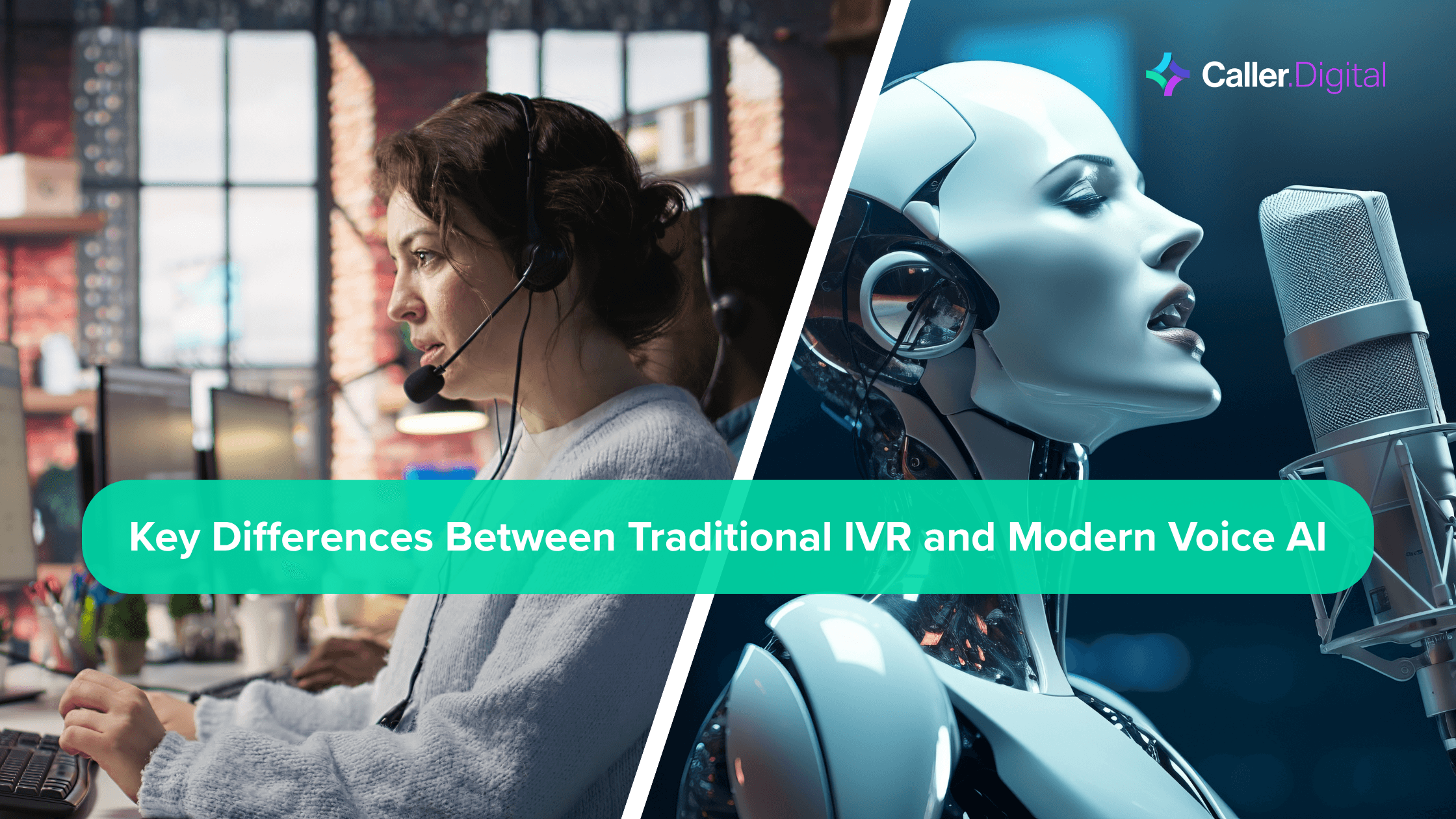
Summary: Traditional IVR systems follow a rigid menu and static language that often frustrated customers. On the other hand, Modern Voice AI systems understand the intent or context of the customer query and provide personalized responses accordingly. A human-like conversation with voice AI agents, improves customer satisfaction, reduces business operations cost and builds customer loyalty.
For many decades, people believed in voice call support. Even after the rise of chat, email, and social channels, voice calls are always the first choice of customers. However, there is a glitch when a phone call on a traditional IVR system starts with 'press 1 for sales, press 2 for support.' It is a never-ending maze that becomes frustrating, and the chances of call drop-offs increase.
But now in this technical world, voice AI is changing reality and refining customer experience. It is true that IVR (Interactive Voice Response) and voice AI both communicate with customers over phone calls or voice channels, but the operating systems of both are different. The conversational AI agents use natural language processing (NLP) methods to understand the context and intent of the customer, which helps to respond quickly in real-time. Whether you are a start-up company or a large MNC, AI-powered agents always deliver smoother, smarter, and more human-like interactions.
What is Traditional IVR?
Interactive Voice Response (IVR) has been the backbone of customer service and automated phone solutions for so many decades. Popularly, traditional IVR is best known for its rigid menu options like press 1 for sales, press 2 for support, and others. When IVRs are integrated with CRM systems, they can handle everything from routine queries to more complex queries.
However, traditional IVR systems often have a limit of working scale and with its static nature, it becomes unsuitable for today’s customer expectations.
The core features of the IVR system are:
- Rigid menu-based navigation
- No dynamic interaction and limited personalization
- High call drop-offs and abandonment rates
- Rule-based call flows with no context understanding.
What is Modern Voice AI?
Voice AI refers to a conversational AI system that can detect, understand, and respond to customers' frequently asked questions (FAQs) in natural language. Unlike IVR, voicebot agents are built using Natural Language Processing (NLP), Machine Learning (ML), which enables computers to learn from data, and speech recognition technologies that allow them to communicate in human-like language.
Because of this, an AI voice agent can manage multi-purpose conversations, follow-up questions, and routine calls at the same time. Virtual voice assistants are not limited to scripts; instead, they interact with customers by identifying the intent (purpose) and context (background details) of the problem.
The core features of Modern voice AI agents are:
- Understand natural language and intent while interacting.
- Omnichannel integrations work for voice, chat, and social media channels.
- Handle a high volume of calls simultaneously with no manual effort.
- Access to real-time data to pull customer details
Traditional IVR Vs Voice AI
| Feature | Traditional IVR | Modern Voice AI |
|---|---|---|
| Mode of interaction | Limited to keypad inputs | Conversational, natural with speech recognition |
| Personalization | Rule-based, rigid to menu | Dynamic, customizable |
| Flexibility | Fixed to static menus | Adaptive communication after understanding context |
| Resolution time | Long wait times due to menu navigation | Fast responses with instant query resolution |
| Customer experience | Frustrating with high call drop-offs | Intuitive, smooth, natural human-like |
| Cost efficiency | Upfront cost low but operational cost is high | Low operational cost with long term ROI |
Advantages of voice AI over Legacy IVR systems
-
Strengthen Customer Experience
Automated phone systems enable the free-flowing of calls and improve conversations in natural language. In this process, customers don’t have to wait for long or remember menu structures; rather they simply have to ask for queries and get immediate responses.
-
Reduce Call Handling Time
Voicebot agents directly address queries by accurately detecting intent and understanding context. This approach decreases response time and raises first call resolution (FCR) rates.
-
24/7 Availability
Unlike traditional IVR, AI-enhanced IVR agents can operate 24/7 without breaks and are always available for customer engagement.
-
Seamless Integration
Call center automation connects voice bots to CRMs, ERPs, and ticketing platforms, which helps to guarantee real-time responses and personalized conversations.
-
Scalability and Cost Reduction
Voice AI handles seasonal spikes effortlessly as well as manages campaign-driven call volumes without any staffing cost. This not only maintains the business growth but also reduces the overall operational cost of the company.
When to use IVR vs Conversational AI
In today’s time, conversational AI is superior, but in some cases, traditional IVR is still required.
| When Use IVR | When Use Voice AI |
|---|---|
| For simple call routing to internal departments | For delivering personalized and context-driven customer experience |
| When budget is limited then use smart IVR system | For integrating CRM/ERP system |
| When call volumes are low so no need to deploy AI | Dynamic call routing system for handling large call volumes |
Future of Call Center Automation with voice AI
The AI-first strategies shaped the next decade of call center operations with intelligence and advanced technologies. It is more of an emotional AI, giving a personalization effect, proactive customer engagement with multilingual capabilities, and complete omnichannel synchronization.
-
AI voice agents understand the mood, intent, tone, and sentiments of customers and respond accordingly.
-
Imposing predictive analysis to detect customer needs and give personalized responses.
-
Outbound AI-driven calls proactively interact with customers in their preferred languages.
-
Higher efficiency with lower cost for enterprises will position voice AI as a cornerstone of digital transformation.
Conclusion
Traditional IVR systems started to automate call routing, which somehow reduced human dependency and scaled customer support. But now in today’s world, where customers are expecting immediate, personalized, and accurate responses, IVR feels frustrating for them.
Voice AI agents came into the front picture, bringing conversations of customer support to life again. The virtual voice assistant first listens to the query, understands the intent, and responds in natural human-like language.
For businesses, it is a significant cost-saving opportunity and a stronger way to build customer trust. With AI agents, customers experience not only satisfaction but an elevated, modern support journey.
Voice AI will continue to pave the way for future-ready customer support, enabling companies to build sustainable growth and customer loyalty in a rapidly evolving landscape.
