Multimodal Voice Agents: When Voice + Visual + Text = The Future of Conversational AI
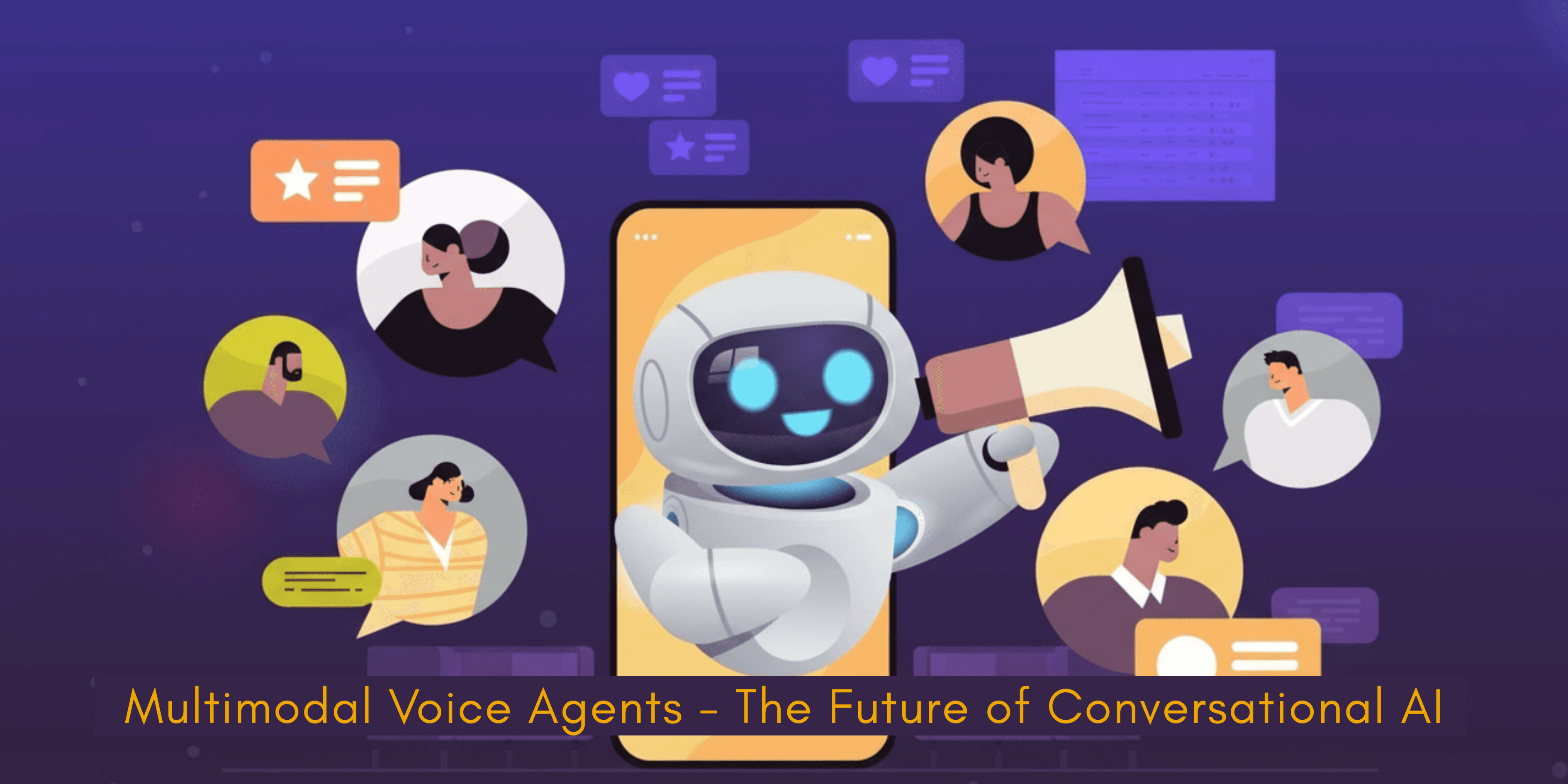
Summary - Multimodal AI agents interact with customers in a human-like manner and understands their issue through speech, facial expressions, gestures, and tone. It provides services across industries like retail, education, real estate, healthcare, and others.
In one way or another, Artificial Intelligence (AI) has advanced dramatically, and the emergence of Multimodal AI Agents is among the most revolutionary developments. These intelligent systems provide human-like comprehension and responses through the use of text, graphics, audio, and other media. Any company seeking to develop more effective, user-friendly, and context-aware AI solutions can utilize this revolutionary option.
You will learn in-depth information about multimodal voice agents in this blog, including what they are, where they truly provide value, how multimodal AI agents work, and why they are the future of agentic AI experiences.
This section contains all the information you need to understand multimodal AI, the possibilities of these agents, and how to begin creating your own, regardless of whether you are a developer, startup founder, enterprise leader, or tech enthusiast.
What is Multimodal AI?
Intelligent virtual assistants called multimodal Al agents are created to enhance perception, decision-making, and interaction with digital surroundings.
To put it another way, a multimodal Al agent represents a change from the way Al typically functions. In other words, a multimodal AI agent may process many data kinds simultaneously, while standard AI models typically use a single type of input, such as text or image. Modalities are the collective term for these inputs, which consist of:
- Natural Language (Text)
- Visual Recognition (Images)
- Speech & Sound (Audio)
- Motion & Action (Video)
- GPS, Temperature (Sensor data)
All of these inputs are combined by voice-driven AI systems, which comprehend context more deeply and accurately. Interactions become more human-like and intelligent as a result. Because of these factors, multimodal AI (voice + vision assistants) is becoming a crucial element in agentic AI development, where intelligent systems must be able to think, adapt, and make decisions on their own.
How Multimodal AI Agents Work?
Multimodal machine learning methods, sensor fusion algorithms, and multimodal neural networks are among the technologies used by a multimodal AI voice agent. The figure of the multimodal AI architecture comprises:
- Input Layer: Receives data from many sources, such as sensors, cameras, and microphones.
- Encoding Layer: Converts the input into embeddings.
- Fusion Layer: Neural fusion networks are used to combine the features.
- Decision Layer: Produces actions by using logic or reinforcement learning.
Multimodal AI Vs Single-Modal AI
| Single-Modal AI | Multimodal AI |
|---|---|
| These systems are made to deal with specific kinds of data. | These systems can handle multiple data types simultaneously such as speech, tone, facial expressions, sentiments, etc. |
| For example – A text-based chatbot that can respond to your inquiries but is unable to "see" an image you provide. | For example – if you show a photo of a broken automobile part to a multimodal agent and say, "I need to order a replacement for this," the agent would comprehend the visual context of the image and the purpose of your spoken command before searching for the item. |
| The capabilities of single-modal AI are restricted to particular domains. | The AI-powered communication of multimodal agents is not restricted to any limit. |
Build a Multimodal Voice Assistant
The following are the steps to begin creating a multimodal AI agent:
Step 1: Select Your Modalities. Choose the sorts of data that your agent will process. For example, music, video, text, etc.
Step 2: Choose a Structure. Make use of a multimodal AI framework such as Flamingo, ImageBind, or CLIP.
Step 3: Integration and Labelling of Data. Pre-process the supplied data and make use of multimodal integration tools.
Step 4: Model Training Construct or refine a multimodal neural network.
Step 5: Use APIs for Deployment. To deploy the agent on cloud platforms, use the multimodal AI API.
Real-World Benefits of Multimodal AI for Enterprises
Healthcare
To make a diagnosis more rapidly and precisely, a multi-modal agent could examine a patient's electronic health information, X-ray scans, and transcribed notes from a physician. For the early diagnosis of illnesses like cancer, this might be revolutionary.
E-commerce & Retail
Consider a multimodal shopping helper. You may tell it your size, show it an image of a dress you like, and then explain why you need it. From thousands of options, the agent may then select the ideal dress for you, providing a highly customized shopping experience.
Education
A more interesting and successful learning process might be produced by multi-modal agents. By analyzing a student's scribbling on a tablet, listening to their spoken inquiries, and presenting a visual picture to clarify a difficult topic, an agent may instantly modify its teaching approach to meet the needs of the learner.
Robotics & Autonomous Systems
A robot must simultaneously perceive its surroundings, hear commands, and evaluate sensor data in order to navigate a complicated environment. The development of fully autonomous robots that can engage with the real world in a secure and intelligent manner depends on multi-modal AI. For example, autonomous cars use multi-modal data from radar, lidar, and cameras to make snap choices.
Challenges in Implementing Multimodal Conversational AI
Building multimodal Al agents has its own set of difficulties despite the possible benefits. These consist of, but are not restricted to:
- It takes a lot of time and effort to align various data types.
- Larger datasets and more processing power are needed for these models.
- Contradictory signals may arise since it uses many modalities.
- Performance may eventually be slowed down by real-time processing across inputs.
- More data layers make it harder to comprehend the agent's choices.
Why is Multimodal AI the Future of Conversational AI?
Agentic AI entails creating intelligent systems that are capable of independent thought, decision-making, and action. By enabling Al systems to work with multi-input AI models like text, images, and speech, multimodal Al agents represent a significant advancement and enable businesses to create apps that interact with the actual world in a manner similar to that of humans.
When the environment requires context outside of the taught input, traditional single-modal agents are unable to react. On the other hand, multimodal Al systems and multi-sensor Al agents provide superior comprehension, which makes them ideal for sectors such as autonomous vehicles, robotics, and healthcare.
Conclusion
The future of multimodal AI agents lies in autonomous agentic ecosystems, which are capable of interacting with people, environments, and other agents. As a result, we may anticipate that they will make judgments in real time, converse naturally, and navigate physical spaces.
Building in multimodal AI solutions will be an important advantage for prospering in a dynamic market, as companies and developers eagerly anticipate innovation. Next-gen Al agents with practical applications will result from the combination of agentic Al development concepts with multi-modal Al frameworks.
Frequently Asked Questions
Tags :