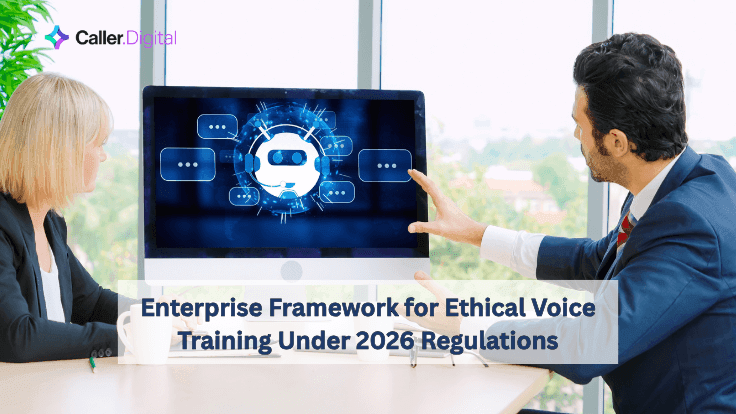
Enterprise Framework for Ethical Voice Training Under 2026 Regulations
Summary- To support the customers, to enhance service quality, and to automate operations, the voice AI technology is being actively acquired by companies. The companies are responsible for training their voice bots in a way that they prioritise fairness, safety, and transparency. The following blog expands on how companies can include ethical training, perpetuate regulatory compliance, and create reputable voice-based experiences that go hand in hand with the requirements of 2026.
In the modern period, voice technology has become a key element around which enterprise communication and customer support revolve. Ever heard the famous dialogue - “ With great power comes great responsibility”? This is what applies to Voice technology also. As global adoption of voice technology increases, the obligation of ethical handling of data and protection of users also increases.
Companies are now required to follow strong voice ethics and compliant training practices, which are suitable for the growing standards for privacy and transparency of the global regulations, workflows and governance principles are outlined in the following blog, which can help enterprises build safe and reliable voice technology for large-scale use.
Why Ethical and Compliant Voice Technology Matters in 2026?
Enterprises have started to depend on voice AI systems since the volume of customer interactions has increased with each passing day. When all of this happens, the heat to maintain fair and secure operations also increases.
-
Use of Global Voice Systems
Voice bots are being used by most of the organisations, which raises the expectations for reliability, transparency, and secure operations with strong enterprise compliance.
-
Higher legal exposure due to new regulations
The voice-driven systems are treated as sensitive in many regions. They consider it to be of high risk. Trespassing the boundaries in such situations can lead to penalties and services being suspended forcefully.
-
Consumers anticipate honesty and openness
Consumers from all over the world demand openness regarding the use, storage, and security of their voice data. The only way to establish trust is through communication that adheres to actual safety regulations. Fairness and responsible governance - Both experience and compliance are harmed by any kind of discrimination, be it based on accent, gender, or linguistic characteristics. The governance frameworks are intended to serve as an important foundation for this.
Understanding the Global Regulatory Landscape for Voice Technology
The regulations are the deciding factors of how enterprises ought to document, guide, and monitor voice-based systems. A condensed summary of the main frameworks influencing regulatory compliance in 2026 is provided below.
EU AI Act, High-Risk Classification
- Detailed documentation, transparency reports, risk logs, and accountability are required.
- Strict governance frameworks require undivided attention.
United States, NIS,T, and Safety Institute
- Fairness, explainability, and continuous monitoring are prioritized.
- Expectations around risk management are braced.
United Kingdom, Safety and Transparency Standards
- Requires interpretability tools and documented assessments.
- Reinforces model transparency obligations.
India, DPDP Act, and New AI Framework
- Requires consent-first data handling, clear storage policies, and privacy-safe processing.
- Critical for enterprises that must maintain strong data protection.
Middle East, UAE, and Saudi Regulations
- Treat voice signatures as highly sensitive information.
- Encryption, consent, and auditability are mandatory under compliance standards.
Ethical Principles for Training Voice Models
Guaranteed fairness, transparency, and safety are set on the seal by ethical training, while completing the requirements of enterprises without reducing the service quality during real-time interactions.
-
Transparent Datasets, Accountable Collection, and Bias-Reduced Dataset Design
Ethical development begins with responsible data sourcing. This includes transparent documentation, consent-driven voice collection, and clear lineage tracking for every dataset used. Corporations shall use distinct and well-balanced datasets to minimise issues like accent, language, and linguistic bias.
This helps companies in maintaining privacy safeguards and also adds fuel to bias mitigation practices, which support in keeping justice all around the globe.
-
Reducing Incorrect Responses and Ensuring Fairness with Consistent Evaluation
Voice models must be trained to avoid unsafe or misleading outputs. This requires safety checks, aligned training patterns, and strong evaluation workflows. Fairness benchmarks should also be tested across different demographic groups to prevent discriminatory behaviour.
This combined approach helps organisations maintain responsible development and uphold model fairness during deployment.
Compliance Requirements for Voice Training
To operate in a regulated environment and avoid any kind of penalties, a defined compliance framework is necessary for companies to follow.
Data protection and privacy controls
A strong privacy foundation includes:
- Masking and anonymising personal data
- Encrypting audio records and ensuring secure data training
- Using consent-based sourcing
- Following strict data retention and deletion policies Note: These practices form the base of enterprise voice compliance.
Risk Classification, Monitoring, Audit Records, and Transparency Documentation
Enterprises are expected to classify risk levels, track real-world behaviour, and maintain clear audit records. Transparency logs, model cards, dataset sheets, and detailed documentation also play a major role in meeting global compliance standards.
Together, these processes ensure accountability, enable regulatory reviews, and support long-term dataset governance best practices.
How to Train Voice Systems Safely: An Enterprise Workflow?
Enterprises can reduce risks and maintain compliance by following a structured training workflow.
Step 1: Collect ethical and diverse voice datasets
This involves consent-first sourcing, demographic diversity checks, and maintaining metadata required for ethical dataset creation.
Step 2: Apply bias reduction and dataset governance
Organisations should rebalance datasets, measure accent accuracy, and use dataset bias reduction practices throughout training.
Step 3: Train using governance-aligned pipelines
A compliant pipeline includes metadata tracking, transparency labelling, and built-in safety checks that support responsible development.
Step 4: Conduct evaluations and compliance audits
Fairness tests, safety audits, and behaviour analysis should be run with professional audit tools before deployment.
Step 5: Continuous monitoring and risk auditing
Regular testing ensures consistent behaviour and preserves long-term voice ethics and regulatory alignment.
Technologies That Support Ethical and Compliant Voice Systems
Several technologies help enterprises strengthen governance and maintain safe training workflows.
- Audit tools and monitoring platforms - These tools score fairness, track behaviour, and help enforce strong governance frameworks.
- Dataset governance platforms - These systems support dataset versioning, consent tracking, and metadata documentation aligned with dataset governance.
- Interpretability and transparency tools - Explainability systems guarantee adherence to interpretability standards and assist teams in comprehending how a model generates its outputs.
- Encrypted storage and privacy protection - Voice data must be kept in safe spaces that meet the requirements of the international privacy safeguards.
- Ethical Challenges and Real-World Risks in Voice Training - Even with a careful design, companies should always be ready to face the common ethical challenges.
- Deepfake misuse and impersonation - Synthetic voices can be used irresponsibly and harm trust without proper safeguards.
- Accent bias and inconsistent accuracy - Insufficiently diverse datasets often lead to unfair response accuracy and customer dissatisfaction.
- Incorrect responses in customer support - Hallucinated answers create risk and a poor customer experience. Safety filters and active monitoring help avoid this.
- Over-reliance in sensitive environments - In very critical situations, Voice systems can never replace human judgment. The clarity in rules helps in establishing responsible use.
Enterprise Checklist: Is Your Voice System Compliant in 2026?
- Does your system meet global requirements such as the EU AI Act, NIST, DPDP, and UAE frameworks?
- Is your dataset ethical, diverse, and transparently documented?
- Are model cards, transparency logs, and dataset sheets properly maintained?
- Do you version-control datasets and monitor performance over time?
- Have you updated risk classification and governance procedures?
Conclusion:
Enterprise operations will be significantly impacted by voice technology. In the coming year, only the systems that follow the principles of fairness, transparency, and governance will be able to meet the regulatory expectations. Voice systems that are secure, inclusive, and reliable can only be procured by the implementation of very strong voice ethics and strict regulatory compliance.
Frequently Asked Questions
Tags :