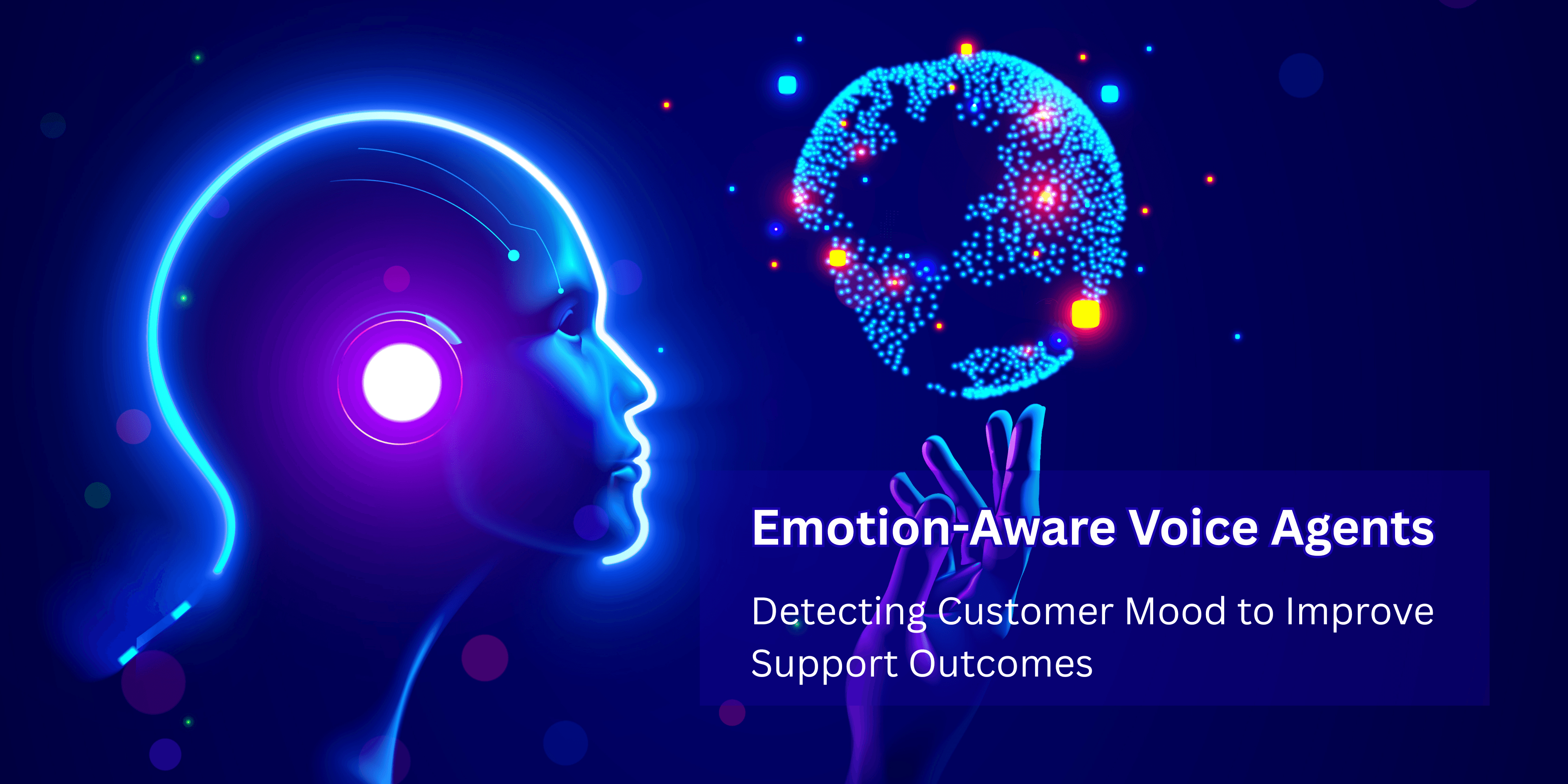
Emotion-Aware Voice Agents: Detecting Customer Mood to Improve Support Outcomes
Summary - Emotion-aware voice agents enable enterprises to interact with the customers in real-time by detecting their intent, context, and emotions. The continuous training of AI models by using large language models (LLMs) and human-labeled datasets refine the accuracy of responses. Through emotion-aware voice AI, businesses must be proactive to achieve efficient outcomes.
In today’s highly competitive environment, enterprises across industries are experiencing customer dissatisfaction. A high number of missed calls, unresolved queries, and poor operational functions are hindering business growth in the market. Traditional customer support typically offers limited customer interaction and low query resolution rates.
To enhance customer experience, enterprises must go ahead with emotion-aware conversational AI platforms like Caller Digital. The Voice AI customer support reduces response times, handles routine calls, and gains actionable insights from conversations.
An AI customer service agent has the capability to detect and identify the intent of the issue that enables businesses to understand the caller's mood, context, and tone, and provide resolution in real-time based on the same.
The combination of NLP (Natural Language Processing), speech recognition, and machine learning algorithms not only figures out customer frustration but also understands the urgency of the problem. From start up to big MNCs, every enterprise must use AI emotion detection to improve customer experience and drive retention.
How AI Identifies Emotions Over Calls?
AI sentiment analysis looks into both the words and speech patterns of customers to assist businesses in understanding how they are feeling during calls. Imagine having an extremely intelligent assistant that is able to pick up on every nuanced clue in a discussion, from the words themselves to the minute variations in a person's voice.
-
Acoustic Analysis
During voice sentiment analysis, AI detects pitch, tone, amplitude, and speech rate of the customer’s voice. For example - if the pitch is high or elevated, then it often indicates frustration or urgency, whereas a soft and slow tone may signal dissatisfaction.
-
Linguistic Analysis
An intelligent AI virtual assistant uses NLP models to identify and evaluate the context and syntactic content of the conversation. The emotional state of the customer depends on certain phrases, word choice, and sentence structure.
-
Contextual and Behavioral Signals
Voice AI customer support tracks the history of customer interactions for identifying behavioural patterns and connecting multiple touchpoints of the issue. This helps AI agents to detect and anticipate the next response in real-time.
Key Technologies Used by Voice AI Agents to Detect Emotions
Every emotion-aware voice agent backbone is in its technological stack through which we can integrate multiple AI information and data processing frameworks.
-
Speech Recognition Engines
The first stage is to convert audio signals into text that can be read by machines. Deep learning-based automated speech recognition (ASR) method is used by modern engines to manage a variety of accents, tones, background noise, and multilingual support.
-
Natural Language Processing (NLP)
NLP models are used to examine the emotional side of text transcripts and the contextual meaning of the conversation with customers. These models are optimized to recognize minor emotional indicators in contact center conversations.
-
Machine Learning for Emotion Classification
The AI in customer support is trained on labeled datasets using advanced learning to categorize emotions including happiness, rage, sadness, frustration, and neutrality.
-
Sentiment Analysis Algorithms
Artificial intelligence detects positivity, negativity, and neutrality in text and voice by fusing deep learning sentiment models with lexicon-based methods. This is further improved by Caller Digital through continuous learning, which modifies models in response to feedback and fresh call data.
-
Real-Time Analytics & Predictive Modeling
Monitoring of real-time emotion detection can be done by analyzing dashboards, alerting agents to handle critical customer moods. Using sentiment trends from discussions to outcomes, predictive modeling can predict possible escalations or churn concerns.
Teaching AI to Understand Emotions

Emotion-aware conversational AI systems can learn to identify emotions in customer calls by combining language analysis with informed human input. Think of it like training a new employee, instead of educating a human to sense customer mood, just like the same way we are teaching AI.
-
Using Large Language Models to Advance AI
Big language models have some advanced technical powers through which they can easily learn text instances and interact in a human-like manner. In order to identify emotions, different algorithms must be used during conversations with customers.
-
AI Training with Human Input
Human experts play a critical role in teaching AI about emotions. They go over thousands of conversations with clients, recording different feelings and responses. This facilitates voice AI's ability to easily identify differences between irritated and genuinely sad people.
How AI Emotion Detection Helps Customer Service?
AI can be compared to your customer service team's emotional radar. Real-time conversation listening allows it to pick up on emotional cues that even experienced agents could overlook.
-
Enhanced Customer Satisfaction – AI agents can react proactively to unfavorable sentiment, thanks to real-time warnings, which guarantee timely resolution and lessen customer frustration.
-
Optimized Call Routing – Voice AI routes calls to senior agents or specialist teams when it detects high-priority or emotionally charged calls. This enhances first-call resolution (FCR) and lowers escalation rates.
-
Data-Driven Insights – A large dataset for tracking trends in the customer experience, assessing agent performance, and locating systemic service problems is offered by emotion detection analytics.
-
AI enables more personal interactions by aligning the conversation with the customer’s mood. When a customer is satisfied, agents can introduce new products or services, taking advantage of positive sentiment.
-
Operational Efficiency – By automating sentiment analysis, human agents can concentrate on more difficult queries because less manual labor is needed for call evaluation.
Why Emotion Detection Matters For Small Businesses?
Small businesses must provide excellent customer service without going over budget. This is made feasible by AI emotion detection, which makes excellent customer service accessible.
-
Boost Customer Satisfaction
When customers' emotions are read and respond in real-time, then a strong connection is established between business and customer. Even giving small attention to customer queries and resolving them instantly builds great trust and loyalty towards the business.
-
Better Business Decisions by Using Emotion Data
AI phone answering services use their understanding methods to detect customer emotions and improve services. They evaluate sentiment, precise issue and area of improvement.
-
Scalable Customer Service With No Charges
Emotion detection allows you to provide individualized, compassionate service without having to hire a large number of support people. In terms of customer service, this implies that small enterprises can compete with larger ones.
Conclusion
AI emotion recognition is changing customer care by enabling companies to instantly understand and act on customers' emotions, leading to better outcomes and communication. Using machine learning and natural language processing, teams can respond more effectively to each customer's emotional state.
Choose AI programs that have learned from a large number of customer interactions. Work on enhancing their emotional reading skills after that. Use all of your knowledge to give them the kind of service that truly understands them.
Frequently Asked Questions
Tags :