AI Assistants for Customer Service: The 2026 Enterprise Playbook
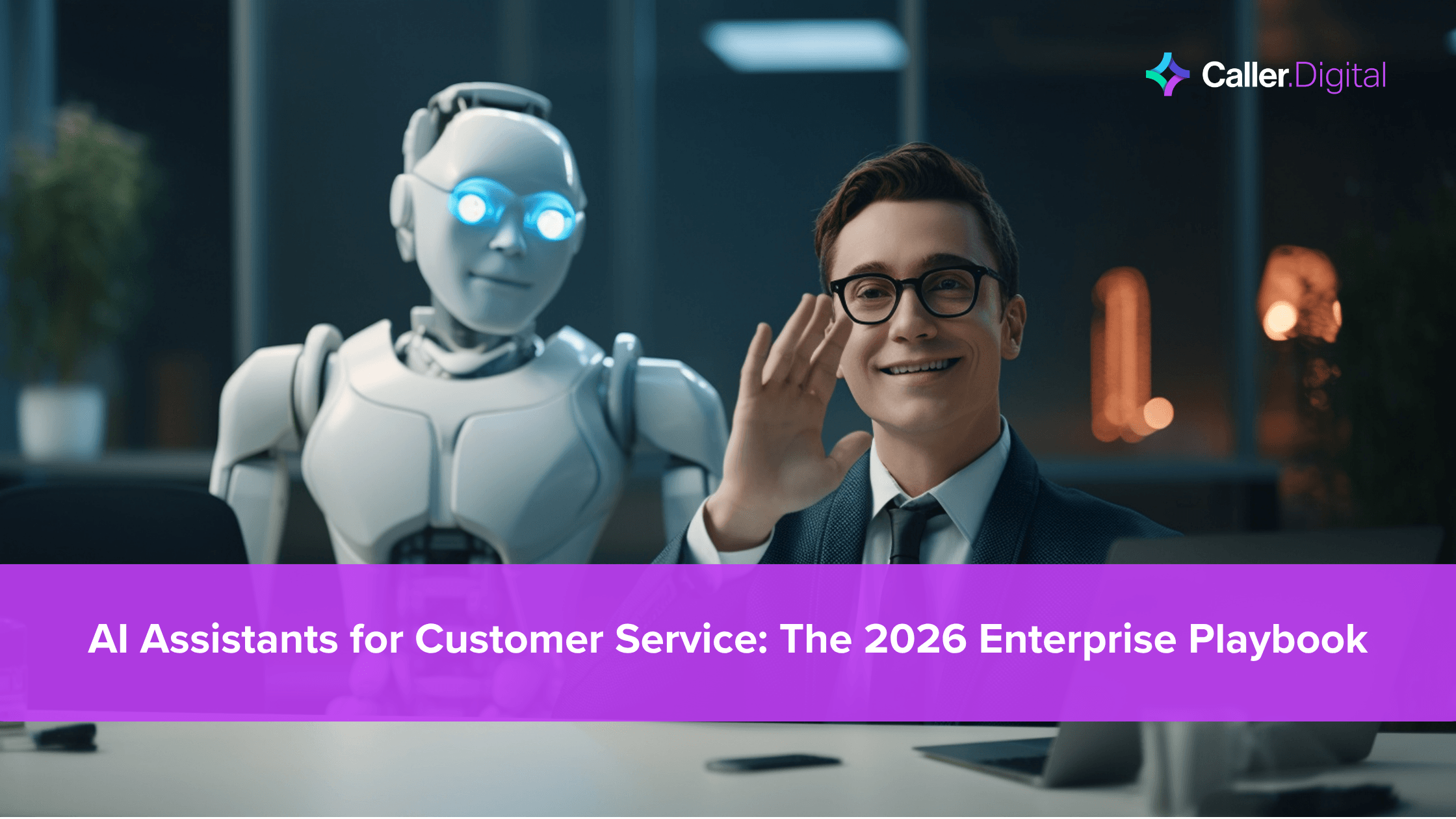
There are two AI assistants in the enterprise today and they do very different things. One sits inside your employees' tools — Slack, Salesforce, Outlook, Jira — and makes the employee more productive. Microsoft Copilot, ChatGPT Enterprise, Glean, Claude. The other sits in front of your customers — on the phone, on WhatsApp, on web chat — and resolves their requests end to end. Both are called "AI assistants." Both cost similar amounts. They produce completely different ROI curves.
This playbook is about the second kind: the customer-facing AI assistant. It is about voice and chat AI assistants that take calls from your customers, solve their problems, take payments, log tickets, and walk out of the conversation with the customer happier and your CAC lower. For an Indian enterprise with high contact volumes, multilingual customers, and thin unit economics, this is the more load-bearing category. This is the playbook to deploy it.
Productivity AI assistant vs customer-facing AI assistant
Getting this distinction right matters because the vendors, budgets, metrics, and risk profiles are completely different.
| Productivity AI assistant | Customer-facing AI assistant | |
|---|---|---|
| User | Your employee | Your customer |
| Primary channel | Slack / email / IDE / docs | Phone, WhatsApp, web chat |
| Value | Time saved, work quality | Contact deflection, revenue recovered, CSAT lift |
| Vendors | Microsoft, OpenAI, Glean, Anthropic | Conversational AI and voice AI platforms |
| Typical budget | $20–60/user/month | ₹2–₹8/minute or per-session |
| Biggest risk | Data leakage, wrong suggestions | Compliance, customer trust, regulator action |
| Dominant incumbents | Microsoft, Google | Still fragmented, India-first leaders emerging |
Both are important. This playbook is scoped to the second column.
Why customer-facing AI assistants matter for Indian enterprises
Three structural realities.
Cost per contact. Indian enterprises run customer operations at unit costs that simply do not work with human-only agents at scale. A 100-seat contact centre handling 3 lakh conversations a month at ₹40/contact is ₹1.2 crore a month — unaffordable for mid-market margins. An AI assistant handling 70% of that volume at ₹5/contact brings the total cost per conversation down to ₹15–18. At 36 lakh contacts a year, that is a ₹10–12 crore P&L swing.
Languages. Your customer wants to speak Tamil. Your agent pool speaks Hindi and English. An AI assistant that speaks 14 Indian languages fluently turns a limited-language contact centre into an any-language contact centre overnight.
24×7. Your customer's WhatsApp message arrives at 11pm. Your contact centre closed at 7pm. An AI assistant never closes. For e-commerce, logistics, and financial services, the after-hours window is 30–45% of intent volume.
The architecture of a production customer-facing AI assistant
Seven components, in order of the conversation.
1. Reception and intent detection
The AI picks up the call or message, identifies the customer, and classifies intent in the first 1–2 turns. For high-volume repetitive intents (COD confirmation, order status, bill enquiry), the classifier is simple. For open-ended support, the classifier is LLM-based.
2. Authentication and authorization
For anything touching account-level data, authenticate before proceeding. Options: OTP to registered number, voice biometrics, account number + DOB, KYC callback. The authentication layer is where most DPDP incidents originate — log every step.
3. Knowledge grounding
The AI retrieves from your authoritative knowledge base — policy documents, SOPs, product catalogue, FAQs. Never let the LLM free-wheel. Grounded retrieval with citation is what separates a production AI assistant from a hallucinating chatbot.
4. Reasoning and workflow
The LLM reasons over customer intent + retrieved knowledge + conversation history, then decides the next action. For transactional workflows (cancel order, modify policy, initiate refund), the AI reads the intended action back for verification before executing.
5. Action execution
API calls into your CRM, order management, ticketing, payments. The action layer needs idempotency, retries, and HMAC-signed webhooks. Failures should not repeat the action, and every action should leave an audit trail.
6. Channel expression
Voice AI speaks. Chat AI sends rich cards with buttons. WhatsApp AI uses Meta's native templates and interactive messages. The expression layer is channel-specific; reuse of the same agent across channels requires a platform that handles channel adapters natively.
7. Handoff and escalation
The AI detects ambiguity, frustration, or explicit requests for a human. It hands off with full context — transcript, intent, customer details, attempted resolution steps — so the human agent starts mid-conversation, not from scratch. The quality of this handoff is the single biggest driver of CSAT in hybrid AI-human deployments.
The 10 customer-facing AI assistant use cases with the fastest payback
Ranked by typical payback timeline from deployment.
- Order status and tracking — 70–85% containment, payback in 4–8 weeks.
- COD confirmation and RTO prevention — 25–40% RTO reduction, payback in 6–10 weeks.
- Appointment scheduling and reminders — 30–45% no-show reduction, payback in 6–12 weeks.
- Bill payment and renewal collection — 40–55% collection rate, payback in 8–14 weeks.
- Policy/coverage/product FAQ deflection — 60–75% call deflection, payback in 10–14 weeks.
- Lead qualification and routing — 3–5× inbound lead throughput, payback in 8–16 weeks.
- Abandoned cart recovery — 18–27% cart recovery, payback in 6–12 weeks.
- CSAT/NPS capture — 3–5× response rate, payback in 12–20 weeks (indirect ROI via retention).
- Dispute triage and status updates — 40–50% first-contact resolution lift, payback in 10–16 weeks.
- KYC and onboarding guidance — 20–30% drop-off reduction, payback in 14–20 weeks.
The first three are where every Indian enterprise should start. Exotic use cases come later.
Build vs buy vs blend
Three paths. Pick based on your engineering depth, timeline, and differentiation strategy.
Buy (platform)
Licence an off-the-shelf conversational AI or voice AI platform (Caller Digital, Yellow.ai, Kore.ai, Retell, Bland, Cognigy). Configure prompts and integrations. Go live in 4–12 weeks. This is the right default for 80% of enterprises.
Pros: fast, managed, compliant-by-default, predictable cost. Cons: limited customisation, vendor dependency, model flexibility capped.
Build (custom)
Stitch together best-of-breed components — Deepgram or Reverie ASR, OpenAI/Anthropic LLM, ElevenLabs or Cartesia TTS, your telephony, your orchestration layer. 4–9 months to production.
Pros: full control, best-of-breed at each layer, differentiated IP. Cons: slow, expensive (2–8 engineers for 6–12 months), requires sustained voice AI expertise on staff, compliance and ops are your problem.
Build if: you have 10L+ calls/month, a 10+ engineer AI team, and voice is core to your product (not support).
Blend (platform + custom agents)
Licence a platform but build custom agents on top of their primitives. Typical for mid-enterprise with sophisticated use cases. 6–14 weeks for most workflows.
Pros: speed of platform + flexibility of custom. Cons: platform constraints still apply; heavy custom work may recreate what you were trying to avoid.
Most Indian enterprises should buy. The small fraction that genuinely need to build usually know it already.
How customer-facing AI assistants integrate with your stack
The five integrations that always come up.
CRM (Salesforce, HubSpot, Zoho, LeadSquared)
The AI assistant must read customer context before the conversation starts (account, history, preferences, language) and write every outcome back (transcript, intent, resolution status, next action, AI confidence). The writeback is the single most important architectural decision — downstream analytics, next-best-action, and human follow-up all depend on it.
Helpdesk and ticketing (Freshdesk, Zendesk, Kapture, Zoho Desk)
Tickets created by the AI should be flagged as AI-created, include the full transcript, and be routable by intent. For escalations, the ticket is created with human priority and context pre-filled.
Order and inventory (Shopify, Unicommerce, your ERP)
For e-commerce, the AI reads order state, inventory, and shipping in real time. Stale data is customer-facing dishonesty — the AI saying "your order shipped yesterday" when it hasn't is worse than no AI at all.
Payments (Razorpay, PayU, Cashfree, UPI collection flows)
In-conversation payment link generation, verification via webhook callback, confirmation back to the customer. For high-risk use cases (collections, renewals), a recorded verbal confirmation before payment is required.
WhatsApp (Meta Cloud API)
For the hybrid voice-to-WhatsApp handoff and for proactive outbound WhatsApp, the AI needs to speak to Meta's API natively. Template pre-approval, 24-hour window management, and interactive message support are the features to verify.
The Indian compliance layer for customer-facing AI assistants
Three regulations to plumb into the assistant architecture.
DPDP Act 2023
Every AI conversation that touches personal data is DPDP-regulated. Implement:
- Explicit, purpose-bound consent capture at the start of the conversation.
- Consent revocation in-conversation ("stop calling me" should trigger an immediate DNC flag).
- Data access, correction, portability, erasure APIs.
- Retention policies per data category — transcripts, recordings, metadata.
- Breach notification workflow in case of incident.
TRAI DLT
All outbound commercial voice calls go through DLT. The platform needs to register headers, maintain an approved CLI, and honour scrub-list updates in near real time.
RBI FPC, IRDAI, SEBI, MCI
For regulated conversations (lending, insurance, investments, healthcare), the assistant must follow sectoral prescriptions: disclosure scripts, call windows, mandatory recording and retention, grievance redressal path, and no-AI-for-X guardrails (e.g., no AI for clinical diagnosis).
Any vendor that handwaves these is a vendor whose contract you cannot defend to a regulator.
Metrics that matter — don't measure vanity
The six metrics to instrument from day one.
- Containment rate — % of conversations AI resolved without human escalation. Target: 70%+ mature.
- Escalation quality — % of escalated conversations where the human agent rates the AI's handoff context as useful. Target: 85%+.
- CSAT / NPS — post-conversation rating. Target: parity with human CSAT, then +5–10% as the AI improves.
- Cost per resolved contact — total AI + human cost / resolved contacts. Target: 60–80% lower than human-only baseline.
- Business outcome — RTO, collection, conversion, persistency — specific to the use case.
- Regression detection — weekly audit of 1% of calls for tone, accuracy, policy compliance. Target: zero hallucinated policy outputs, zero DPDP violations.
Publish the dashboard. Make the vendor own the numbers. If a metric is stagnant for 60 days, escalate or switch.
Deployment timeline: what to expect in an Indian enterprise
Weeks 1–2: scoping and consent
Use-case scoping, data contracts, DPDP impact assessment, DLT onboarding, integration design. Pick 1–2 starting use cases with clear ROI. Align internal stakeholders (ops, IT, legal, customer experience).
Weeks 3–4: build
Agent prompts, knowledge base ingestion, CRM integration, telephony provisioning, test recordings in target languages. Small internal team test cohort.
Weeks 5–6: soft launch
5–10% of live traffic to AI. Monitor every call. Fix issues daily. Tune prompts, retrieval, and handoff. Expect 20–30% of early calls to surface unexpected edge cases.
Weeks 7–10: ramp
Scale to 40–60% of volume. Add use case #2. Harden escalation. Start building feedback loops into the knowledge base and prompts.
Weeks 11–14: full production
100% of in-scope volume on AI with human fallback. Introduce measurement rituals. Publish monthly outcome reports.
Months 4–12: expand
Add new use cases quarterly. Annual recontracting with the vendor based on measured outcome.
Common deployment mistakes — and how to avoid them
- Automating empathy-required conversations too early. Complaints, grievances, and emotional moments need humans initially. Let the AI grow into them over 6–12 months.
- Skipping the escalation path. A customer who cannot reach a human will churn. Always have the "speak to agent" button.
- Ignoring the tone. Your AI should sound like your brand. A premium BFSI player with a bubbly Hindi TTS is tonally wrong. Audition voices, iterate.
- Under-investing in knowledge base curation. Garbage in, garbage out. The knowledge base is the moat. Staff it like you staff your website content.
- Locking into a single vendor without exit clauses. Data ownership, transcript portability, and 90-day exit terms must be in the contract.
- Not training human agents to work with AI. Humans handling AI escalations need different training than cold call-centre agents. Invest 20–40 hours per agent upfront.
How customer-facing AI assistants get better over time
Three learning loops, in increasing sophistication.
Prompt and retrieval tuning (always on)
Every week: review the bottom 10% of calls by CSAT, identify prompt and retrieval failures, fix them. This alone gets a deployment from 50% containment at launch to 75%+ at 6 months.
Intent expansion (quarterly)
Every quarter: look at the tail of escalated calls, identify the most common unhandled intents, build new intents into the assistant, measure containment lift.
Model fine-tuning or adapter tuning (annual, optional)
At 10 lakh+ calls a year of clean, consented data, consider model fine-tuning on your conversation data for domain adaptation. The gains are real (5–12% containment improvement) but the engineering cost is significant. Most enterprises don't need this before year 2.
Case archetypes: what these deployments look like in 2026
D2C brand, 3 lakh orders/month
Deploys COD confirmation + NDR + abandoned cart voice AI across Hindi, English, Tamil, Telugu, Kannada. Lands at 78% containment, ₹5/resolved contact average, RTO down from 32% to 19% over 4 months. Total savings ₹2.2 crore/year at a ₹65L/year platform spend.
Mid-sized NBFC, 4 lakh active loans
Deploys soft-bucket collections + EMI reminder + KYC guidance AI in 8 languages. Lands at 52% self-serve recovery on soft buckets, ₹8/call vs ₹45/call human cost. Collection rate up 9 percentage points, grievance load down 22%.
Multispecialty hospital network, 120 locations
Deploys appointment booking + reminder + follow-up AI in Hindi, English, Tamil, Marathi, Bengali. Hits 58% call deflection off the reception desk, no-show rate down from 23% to 14%, patient CSAT up 0.7 points.
B2B SaaS, Indian customers across 12 cities
Deploys lead qualification + demo booking + support triage AI on inbound calls and WhatsApp. Hot leads routed within 90 seconds, demo show-up rate up 18%, inbound support first-response time down from 6 hours to 2 minutes.
The pattern across all four: start narrow, measure obsessively, expand quarterly, treat the AI assistant as infrastructure not experiment.
The 2027 roadmap: what to build toward
Three directions.
- Proactive AI assistants. Instead of waiting for the customer to call, the AI calls/messages at the right moment — before delivery, before bill due, before renewal. Most use-case ROI nearly doubles in proactive mode.
- Multimodal assistants. Voice + image + screen share. Customer shows the AI a product defect, AI identifies it and initiates a replacement. Already live in D2C pilots.
- Cross-channel memory. The same AI assistant recognises the customer on the phone today, on WhatsApp tomorrow, on your web chat next week — with full memory of prior conversations. This is the endpoint of what "conversational AI" actually means.
The platforms that get to this state first win the next cycle.
Bottom line
A customer-facing AI assistant is not an experiment for an Indian enterprise in 2026; it is operations infrastructure. Deployed correctly, it takes 60–80% of your contact volume at a sixth of the cost, in every language your customers speak, without closing at night. Deployed carelessly, it erodes customer trust, creates DPDP liability, and teaches your customers that your brand's support is worse than before.
The difference between the two outcomes is method. Start with a narrow, high-ROI use case. Ground the AI in your real knowledge. Integrate cleanly with your CRM and stack. Comply deeply, not superficially. Measure from day one. Expand quarterly. And hold your vendor accountable to the numbers.
Pick the right kind of AI assistant for the problem you have — not the one Microsoft is marketing to your CIO.